Editorial warns health organizations to avoid partnerships with Big Food
Highly processed, calorie-rich food is heavily marketed, highly profitable, and is one of the major causes of skyrocketing rates of child and adult obesity. The ubiquity of such foods in our society is said to create an “obesogenic environment.” So should the American Academy of Family Physicians accept a large grant from the Coca Cola Company to fund a consumer nutrition education website? Should the Heart and Stroke Foundation raise funds by selling pizzas from Boston Pizza? A hardhitting editorial by Yoni Freedhoff and Paul Hébert in the Canadian Medical Association Journal enumerates the benefits to food companies, and the risks to health organizations, in entering into such partnerships.
- For the food industry, partnerships with health organizations buy credibility and consumer loyalty.
- In many cases, partnerships with health organizations directly increase sales, as when Yum! Brands partnered with Susan G. Komen for the Cure to sell buckets of fried chicken.
- Such partnerships may help leverage corporate lobbying efforts, as when Coca-Cola’s CEO used the company’s alliance with AAFP to help argue that soda taxes were unnecessary.
- Although the obesity epidemic is primarily fueled by the consumption of excess calories, these partnerships are used by the food industry to promote the misleading message that inactivity, rather than its products, is the main cause of obesity.
The authors conclude that health organizations, even when desperate for money, should avoid partnering with the food industry. The editorial and an appendix enumerating examples of partnerships between the food industry and health organizations are freely available, so I urge you to read them in their entirety.
See comments by my fellow bloggers Larry Husten, Gary Schwitzer and Howard Brody. Hat tip to Yoni Freedhoff.
Engage with grace blog rally
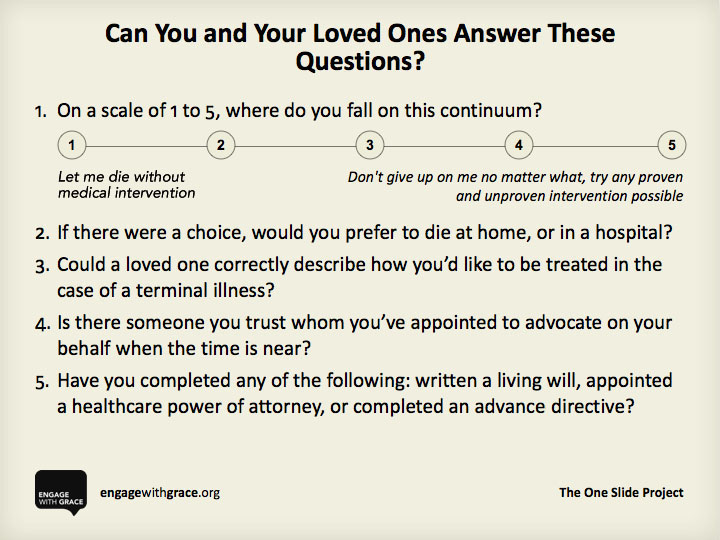
This year I’m joining in the Engage With Grace blog rally. For three years running now, a number of bloggers have participated in a “blog rally” to promote Engage With Grace – a movement aimed at making sure all of us understand, communicate, and have honored our end-of-life wishes. The rally coincides with a weekend when many of us in the United States are celebrating Thanksgiving and are with close friends and family.
At the heart of Engage With Grace are five questions designed to get the conversation about end-of-life started.
To learn more please go to www.engagewithgrace.org

UK group will challenge “CAM” misinformation
I am alerted by Dr. Stephen Barrett’s Consumer Health Digest that a new UK-based group, The Nightingale Collaboration, has been launched by Simon Singh, Alan Henness, and Maria MacLachlan. The group’s website states that “The Nightingale Collaboration will work to improve the protection of the public by ensuring claims made about complementary and alternative therapies are not misleading.” The group will do this by:
- challenging misleading claims made by practitioners on their websites, in advertisements and in their promotional and sales materials and subjecting these to scrutiny by the appropriate regulatory bodies;
- striving to ensure that organizations representing complementary and alternative practitioners have robust codes of conduct for their members that protect the public and that these are rigorously enforced.
Sounds promising. I’m going to be following this new initiative. The group can be followed on Twitter @NightingaleC.
Does garlic lower cholesterol?
Like my last post, this post is inspired by Harriet Hall’s recent review of The Mayo Clinic Book of Home Remedies on the Science-Based Medicine blog. For elevated cholesterol, the book recommends trying “natural products,” including garlic.
In 2007, the results of a randomized controlled trial of garlic on cholesterol concentrations on adults with moderate hypercholesterolemia were reported in Archives of Internal Medicine. The trial evaluated raw garlic and two commonly used garlic supplements. None of the forms of garlic, including raw garlic, when given at an approximate dose of a 4 gram clove per day, 6 days a week for 6 months, had statistically or clinically significant effects on LDL-C or other plasma lipid concentrations.
In addition, a meta-analysis was published in 2008 that did not find beneficial effects of garlic on total cholesterol, LDL, triglycerides, or apoB.
Based on the above, it seems like a waste of time and effort for anyone to try to lower their cholesterol with garlic.
References
Gardner, et al., Effect of raw garlic vs commercial garlic supplements on plasma lipid concentrations in adults with moderate hypercholesterolemia: a randomized clinical trial. Arch Intern Med. 2007;167(4):346-353.
Khoo, et al., Garlic supplementation and serum cholesterol: a meta-analysis. Journal of Clinical Pharmacy and Therapeutics. Volume 34, Issue 2, pages 133–145, April 2009.
Plant sterols for cholesterol-lowering
In a recent post on the Science-Based Medicine blog, Dr. Harriet Hall reviewed The Mayo Clinic Book of Home Remedies. For elevated cholesterol, the book recommends trying “natural products,” including plant sterols. Plant sterols (aka phytosterols) are sold as supplements or in functional foods, such as certain margarines. It is true that plant sterol supplements will usually lower LDL (“bad”) cholesterol by a small amount, in the range of 5-15%. Unfortunately, there is no good evidence that plant sterols lower the risk of heart disease. In fact, it is possible that plant sterols actually promote heart disease.
1. There is a rare genetic disorder called sitosterolemia, characterized by very high serum plant sterols, in which patients develop premature heart disease. It is similar to homozygous familial hypercholesterolemia, except with very high plant sterols instead of very high LDL. The unfortunate victims develop xanthomas containing plant sterols and arteries clogged by plant sterols.
2. Plant sterol supplements have been shown to increase serum plant sterols in healthy people.
3. The safety of these elevated levels of plant sterols has not been established.
4. No clinical trials have been done to test whether plant sterol supplements reduce the risk of heart attacks and, so far as I know, no such trials are planned.
5. There are studies that have found plant sterols in atherosclerotic plaque (e.g., from people who have had endarterectomies) and in aortic valves of patients with aortic stenosis.
6. There are animal studies showing harm from plant sterol supplementation.
For the above reasons, plant sterol supplements cannot be recommended at the present time.
References:
Weingartner, et al. Vascular effects of diet supplementation with plant sterols. Journal of the American College of Cardiology, 2008;51:1553-1561, doi:10.1016/j.jacc.2007.09.074
Teupser, et al. Genetic Regulation of Serum Phytosterol Levels and Risk of Coronary Artery Disease. Circulation: Cardiovascular Genetics. 2010;3:331-339, doi:10.1161/CIRCGENETICS.109.907873
O. Weingartner, M. Bohm, and U. Laufs
Controversial role of plant sterol esters in the management of hypercholesterolaemia
European Heart Journal, February 2, 2009; 30(4): 404–409.


 Marilyn Mann's Blog